
What Is ERP, What Does It Do, and Who Uses It? Efficient ERP Management with İzSor in the Digital Product Passport (DPP) Era
Enterprise Resource Planning (ERP) software unifies in-house operations from manufacturing to accounting in a single database. However, the mandatory Digital Product Passport (DPP) under the EU Ecodesign for Sustainable Products Regulation (ESPR - (EU) 2024/1781) requires extending these records securely beyond the factory gate to customs checkpoints and end consumers. Here is a complete technical and economic guide on connecting your existing ERP software to İzSor for automated DPP compliance and real-time field demand feedback.
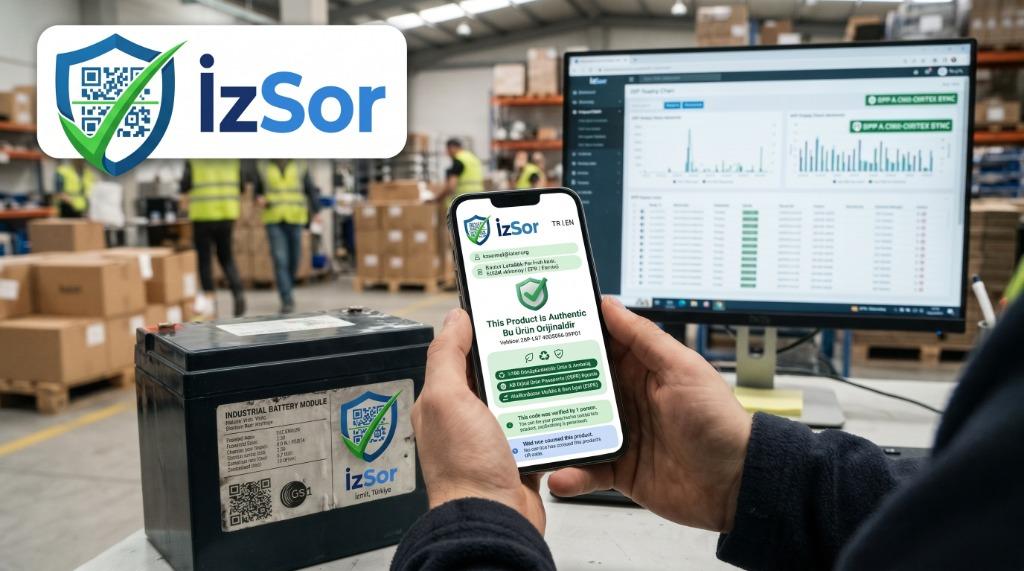
1. What Is Enterprise Resource Planning (ERP)? Historical Evolution and Architecture
Enterprise Resource Planning (ERP) is an integrated software architecture that enables an organization to manage all core business processes—from raw material procurement and manufacturing to warehouse management, quality assurance, sales, foreign trade, and financial accounting—through a single centralized database. In companies operating without an ERP system, production, warehouse, purchasing, and accounting teams rely on disconnected spreadsheets or isolated software tools. This fragmentation causes inventory discrepancies, duplicate data entry, inaccurate raw material orders, and delayed unit cost calculations.
An ERP system ensures that every department views the exact same real-time record. For example, when the sales team enters a new customer order for 10,000 units, the ERP software checks the Bill of Materials (BOM) within seconds, reserves available raw materials in the warehouse, generates purchase requisitions for missing components, dispatches work orders (MRP) to the production floor, schedules quality inspection checkpoints, and automatically records the e-invoice and ledger entries upon shipment.
1.1 Historical Evolution of ERP Systems
Modern ERP suites used across factories and service enterprises today are the result of six decades of industrial engineering and computing evolution (Jacobs & Weston, 2007):
Inventory Control Packages (IC)
Early computerized business systems were designed solely to count raw materials and finished goods in warehouses, calculate Economic Order Quantities (EOQ), and monitor safety stock thresholds.
Material Requirements Planning (MRP)
Bills of Materials (BOM) were combined with the Master Production Schedule (MPS). Software began automatically calculating what product needed to be built, in what quantity, and exactly when each raw material had to arrive at the plant.
Manufacturing Resource Planning (MRP II)
Beyond material quantities, machine capacities, labor shifts, shop-floor scheduling, and manufacturing cost accounting were integrated to create closed-loop factory planning.
Enterprise Resource Planning (ERP) & Cloud ERP
Coined by Gartner in 1990, ERP unified finance, human resources, sales, supply chain, and foreign trade under one system (Jacobs & Weston, 2007). Today, cloud computing and REST APIs allow ERP platforms to exchange data seamlessly with external regulatory and supply chain systems.
1.2 Core Modules That Make Up an ERP System
While customized by industry and company size, a standard enterprise ERP architecture consists of seven interconnected core modules:
1. Bill of Materials & Engineering Management
Stores the exact composition, raw material ratios, semi-finished components, chemical inputs, packaging materials, and technical specifications required to manufacture a product.
2. Production Planning & Execution
Records work orders, production batches/lots, machine routings, energy consumption, scrap rates, and shift-level manufacturing outputs.
3. Inventory & Warehouse Management
Tracks all stock movements from raw material receipt to finished product dispatch by serial number, batch, pallet, shelf life (FEFO — First Expired, First Out), and warehouse bin.
4. Procurement & Supplier Management
Manages purchase orders, country-of-origin certificates, supplier lead times, and input costs for raw materials sourced from upstream vendors.
5. Quality Management
Links incoming inspection records, in-process quality checks, pre-shipment laboratory Certificates of Analysis (CoA), and CE/ISO compliance documents directly to the batch number.
6. Sales, Distribution & Foreign Trade
Manages customer orders, dealer and distributor channels, customs tariff codes (HS/CN codes), export invoices, and packing lists.
7. Finance, Accounting & Cost Control
Aggregates raw material, labor, energy, and overhead expenses at the batch level to calculate true unit production costs and profitability.
2. Who Uses ERP Systems? Industry Adoption and User Groups
One of the most frequent search queries is 'Who uses an ERP system?' Once limited to multinational industrial corporations due to high hardware costs, ERP software is now deployed across all tiers of the economy—from small and medium-sized enterprises (SMEs) to major exporters—thanks to cloud and modular architectures.
According to official European Union statistics from Eurostat (2025), 46.45% of all EU enterprises with 10 or more employees use ERP software to integrate their business processes. Adoption ranges from 41.08% among small enterprises (10–49 employees) to 88.71% among large enterprises (250+ employees). By sector in the EU, ERP usage leads in Information and Communication (61.28%), Manufacturing (57.62%), Energy (54.99%), and Wholesale and Retail Trade (53.77%) (Eurostat, 2025). According to the Turkish Statistical Institute's (TurkStat / TÜİK, 2026) official Survey on Information and Communication Technology Usage in Enterprises, ERP adoption among enterprises with 10+ employees in Türkiye reached 32.3% overall and 39.2% in the manufacturing sector.
Official ERP Adoption Rates in the European Union and Türkiye
Source: Eurostat (2025) E-Business Integration & TurkStat / TÜİK (2026) Release No: 58021
2.1 ERP Usage by Industry Sector
Manufacturing (Textiles, Automotive, Batteries, Machinery, Iron & Steel, Aluminum, Furniture)
The heaviest user of ERP systems for controlling multi-level Bills of Materials (BOM), subcontracted processing steps, batch-level raw material traceability, and scrap rates.
Wholesale, Retail Trade & E-Commerce
Used to manage warehouse inbound/outbound flows, dealer orders, barcoded shipments, and real-time inventory balances across thousands of SKUs.
Chemicals, Pharmaceuticals, Cosmetics & Food Producers
Essential infrastructure for regulatory compliance involving expiration dates (FEFO), batch/lot traceability, laboratory Certificates of Analysis, and cold-chain integrity.
Energy, Services, Logistics & IT Companies
Deployed to standardize project costing, field maintenance operations, spare parts inventory, and financial reporting.
Public Institutions, Healthcare & Infrastructure Operators
Utilize enterprise resource planning software for budget control, public procurement, and medical supply or asset tracking.
2.2 Internal ERP Users by Department
Executive Leadership & Finance (CEO / CFO)
Monitors cash flow, inventory turnover, manufacturing unit costs, and profitability reports in real time.
Production & Planning Engineers
Opens daily and weekly work orders, schedules machine capacity, and calculates material requirements (MRP).
Quality, R&D & Sustainability Specialists
Maintains product formulations, technical test reports, chemical compliance (REACH/RoHS) records, and carbon footprint coefficients.
Warehouse, Logistics & Purchasing Teams
Issues supplier purchase orders, performs handheld terminal scans for goods receipt and dispatch, and manages cycle counts.
Foreign Trade & Export Specialists
Prepares export declarations, customs tariff (HS/CN) codes, certificates of origin, and shipping documentation directly from ERP records.
3. What Does ERP Do Well, and Where Does Traditional ERP Fall Short?
3.1 Core In-House Benefits of ERP Systems
Cross-Departmental Data Integrity
Eliminates duplicate data entry across departments and establishes a Single Source of Truth inside the enterprise.
Raw Material & Inventory Optimization
Prevents production line stoppages caused by material shortages while reducing excess inventory and tied-up working capital.
Accurate Unit Cost Accounting
Captures actual raw material, energy, and labor consumption per production batch to prevent pricing errors.
Batch and Lot Manufacturing Traceability
Allows rapid backward tracing of which raw material lot and production shift were used in any given batch during a quality audit.
3.2 Four Structural Blind Spots of Traditional ERP Beyond the Factory Gate
All traditional ERP platforms—including SAP S/4HANA, Oracle, Microsoft Dynamics 365, Logo, Netsis, Canias, Mikro, and Dia—are engineered to manage operations inside company walls. Once a product is packed, loaded onto a truck, and leaves the factory gate, traditional ERP loses direct visibility over the physical unit. For companies exporting directly or indirectly to the European Union, this creates four major challenges:
Lack of EU Digital Product Passport (DPP) & Customs Verification
The EU Ecodesign for Sustainable Products Regulation (ESPR - (EU) 2024/1781) and the EU Central DPP Registry ((EU) 2026/1778, live since July 20, 2026) mandate that technical, environmental, and circularity data be verifiable via a data carrier (QR code) on the product. The EU Customs Single Window Environment (EU CSW-CERTEX - (EU) 2022/2399) electronically queries the Unique Registration Identifier on import declarations and automatically blocks release for free circulation if a valid DPP record is missing. Traditional ERP databases lack this externally verifiable passport and customs synchronization layer.
Protecting Trade Secrets and Bills of Materials (BOM)
If a manufacturer exposes its raw ERP Bill of Materials (BOM) directly to the public, its sub-supplier list, proprietary alloy or fabric formulations, and cost structure become visible to competitors. Traditional ERP systems do not include a public verification interface capable of filtering product data by stakeholder role in compliance with CEN/CENELEC EN 18239:2026.
Counterfeiting, Cloned Labels, and Grey-Market Diversion
According to the joint OECD & EUIPO (2025) report, global trade in counterfeit goods has reached USD 467 billion annually (2.3% of world trade and 4.7% of EU imports). Standard barcodes or static QR codes printed by traditional ERP systems can be photocopied onto counterfeit packaging. Post-shipment, the ERP cannot tell which physical unit in the field is authentic, which is a clone, or which distributor diverted stock into an unauthorized territory (grey market).
Invisibility of Real End-Consumer Demand and Shelf Velocity
Traditional ERP only sees wholesale invoices issued to distributors. It does not know when the product actually sells off the retail shelf or in which city the end consumer opens it. This blind spot triggers artificial order fluctuations known as the Bullwhip Effect, leading to overproduction or inventory write-offs.

4. How Are ERP Systems Connected to the Digital Product Passport (DPP) and İzSor?
Roughly 80% of the data required for a Digital Product Passport (DPP)—raw material origin, Bill of Materials (BOM), production batch numbers, quality certificates, HS/CN tariff codes, and the energy/material inputs underlying carbon footprint calculations—already resides across various tables inside a company's ERP software. The missing link is an intelligent middleware layer that converts internal ERP records into EU-compliant passports without exposing trade secrets, assigns an uncloneable cryptographic identity to each physical unit, and feeds field verification data back into the ERP. Supported by TÜBİTAK 1812, İzSor serves as this exact ERP–DPP integration and verification layer.
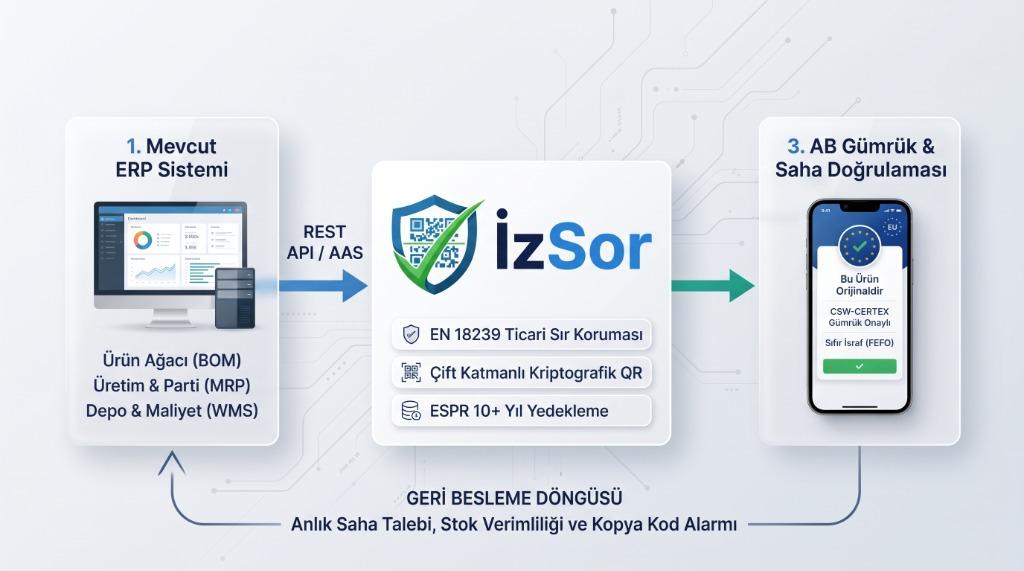
Architectural Comparison: Traditional ERP vs. İzSor-Integrated DPP-ERP
A. Traditional ERP Architecture (Post-Shipment Data Blindness)
- 1.In-House ERP (BOM, MRP, WMS, Quality, Finance)
- 2.Standard Barcode Printing & Wholesale Shipment
- 3.Data Blind Spot: Product Cannot Be Tracked After Leaving the Factory Gate
Outcome: Manual Paperwork at EU Customs (CSW-CERTEX), Easily Cloned Static Barcodes, and Forecast-Driven MRP Based on Delayed Distributor Orders.
B. İzSor-Integrated DPP-ERP Architecture (Two-Way Data & Customs Compliance)
- 1.In-House ERP (SAP, Oracle, Microsoft Dynamics, Logo, Netsis, Canias, Mikro)
- 2.REST API & Webhook → İzSor DPP & Cryptographic Verification Layer (IEC 63278 AAS, GS1 Digital Link, EN 18239 Confidentiality Filter, Dual-Layer QR, ESPR Art. 10(4) 10+ Year Backup)
- 3.1) EU Central DPP Registry ((EU) 2026/1778) & CSW-CERTEX Customs Verification | 2) Field & Consumer QR Scan (Authenticity, Geolocation, Dynamic FEFO)
Closed-Loop Feedback: Real-time consumer demand, cloned code alerts, and grey-market detections from every field QR scan flow directly back into the ERP's MRP, WMS, and Sales modules.
4.1 How Data Flows from ERP to the Digital Product Passport (DPP)
Non-Invasive REST API Connection & Data Standardization
Companies do not need to replace the ERP software they have invested heavily in (SAP, Oracle, Microsoft Dynamics, Logo, Netsis, Canias, Mikro, etc.). İzSor connects to existing ERP production (MRP) and warehouse (WMS) tables via standard REST APIs and Webhooks. When a production batch is released, İzSor automatically transforms raw ERP data into the IEC 63278 Asset Administration Shell (AAS) JSON-LD schema referenced by the European Commission's CIRPASS (2024) architecture and the GS1 Digital Link (URI Syntax v1.7.0) standard.
EU Central DPP Registry ((EU) 2026/1778) & Customs (CSW-CERTEX) Registration
Under Commission Implementing Regulation (EU) 2026/1778 of July 16, 2026, unique product, model, or batch identifiers compliant with ISO/IEC 15459 are generated for each Digital Product Passport. İzSor registers these identifiers with the European Commission's Central DPP Registry, retrieves the Unique Registration Identifier, and writes it back into the ERP foreign trade module's export invoice and customs declaration line. Upon arrival at the EU border, the CSW-CERTEX system electronically verifies this identifier within seconds (ESPR Articles 13 and 15).
Role-Based Access Control Protecting Trade Secrets (EN 18239:2026)
Fully aligned with CEN/CENELEC JTC 24 standard EN 18239:2026 (Access Rights Management, Information Security and Business Requirements), İzSor separates ERP data into three distinct authorization tiers so proprietary Bills of Materials (BOM), supplier pricing, and trade secrets remain 100% protected from competitors:
Product authenticity confirmation, core material composition, carbon footprint summary, user manual, care, and recycling instructions.
Spare part identifiers, safe disassembly diagrams, battery State of Health (SoH), and critical raw material separation guidelines.
EU Declaration of Conformity (DoC), laboratory test reports, technical documentation references, and supply chain audit logs.
Dual-Layer Cryptographic QR Code & Item-Level Authenticity Verification
Traditional ERP systems print the exact same static barcode across 50,000 units of a production run. İzSor assigns a cryptographically signed unique identity to every single item on the production line. Where required, its dual-layer architecture—an outer public QR code for customs and DPP inspection, paired with an inner-lid or scratch-off concealed verification key accessible only to the end buyer—prevents optical copying on retail shelves or during transit.
Mandatory Third-Party Backup & Long-Term Archiving (ESPR Art. 10(4) & EN 18246)
Under ESPR (EU) 2024/1781 Article 10(4), economic operators must store a backup copy of the Digital Product Passport through an independent certified third-party DPP service provider and ensure it remains accessible throughout the product's expected lifetime (10+ years across most regulated categories). Even if a company later migrates to a new ERP vendor or decommissions its local servers, İzSor's EN 18246-compliant cloud archive guarantees uninterrupted statutory availability.
4.2 Mapping Matrix: ERP Modules to the İzSor DPP Layer
| ERP Module | Raw Data Inside ERP | İzSor DPP Transformation & Security Operation | EU Regulation / Standard |
|---|---|---|---|
| Bill of Materials (BOM / PLM) | Material ratios, recycled content, chemical substances | Applies EN 18239 filter to mask trade secrets and split public vs. authority views | ESPR Art. 7 & 9; CEN EN 18239:2026 |
| Production Planning (MRP / MES) | Batch/Lot ID, plant location, timestamp, energy usage | Generates item-level cryptographic QR identities and maps carbon footprint data | ISO/IEC 15459; GS1 Digital Link v1.7.0 |
| Quality Management (QMS) | Laboratory Certificates of Analysis (CoA), CE / REACH / RoHS tests | Converts test records into IEC 63278 AAS digital conformity files (DoC) | ESPR Annex III; CIRPASS AAS Architecture |
| Warehouse & Logistics (WMS) | Serial/pallet IDs, manufacturing and expiration dates | Enables dynamic FEFO shelf-life tracking and territorial shipment binding | ESPR Art. 24 (Prevention of unsold goods destruction) |
| Foreign Trade & Sales | HS/CN tariff code, export invoice, destination country | Registers with EU Central DPP Registry and writes registration ID to customs forms | (EU) 2026/1778 & CSW-CERTEX (EU) 2022/2399 |
| IT & Data Archiving | Local ERP database records | Maintains 10+ year independent third-party DPP backup archive | ESPR Art. 10(4); CEN EN 18246:2026 |
5. How İzSor Turns the DPP Process into an Efficient Closed-Loop ERP System
Many companies initially view the Digital Product Passport as an unavoidable compliance burden for EU exports. When properly architected, however, DPP eliminates the biggest weakness of legacy ERP software: post-shipment field blindness. İzSor transforms DPP from a one-way regulatory filing into a closed-loop operational system that streams real-time market telemetry back into the ERP.
End-to-End Closed-Loop ERP – İzSor DPP – Customs & Field Feedback Workflow
New production batch is approved; BOM, Lot, Quality, and HS/CN data are sent to İzSor via REST API.
Records are formatted into IEC 63278 AAS and GS1 Digital Link schemas; EN 18239 trade secret filtering is applied.
ISO/IEC 15459 identifier registration is completed under (EU) 2026/1778 and the Unique Registration Identifier is issued.
Customs registration ID is written back to the ERP export invoice; unit-level cryptographic QR labels are printed.
Under (EU) 2022/2399, the DPP registration ID on the customs declaration is electronically verified in seconds.
The İzSor QR code on the product is scanned; role-based authenticity proof and Digital Product Passport are displayed.
Real-time consumption velocity, regional demand, dynamic FEFO alerts, and clone/grey-market warnings flow back into ERP MRP and WMS.
5.1 Dampening the Bullwhip Effect and Enabling True Demand-Driven MRP
Formally modeled in supply chain economics by Lee, Padmanabhan, and Whang (1997) and Chen, Drezner, Ryan, and Simchi-Levi (2000), the Bullwhip Effect describes how small fluctuations in retail demand become progressively amplified as orders move upstream through dealers, regional distributors, and the manufacturer's ERP. Because traditional ERP systems cannot see when end consumers actually buy and open products, they forecast demand using delayed distributor orders (q_t). Under a p-period moving average forecast and an L-period information and replenishment lead time, Chen et al. (2000) proved that the ratio of order variance to actual consumer demand variance (D_t) obeys the lower bound:
Equation (1): Single-stage order variance amplification factor under lead time (L) and forecasting window (p) (Chen et al., 2000).
Equation (2): Multiplicative variance amplification across a K-tier supply chain (retailer → regional distributor → master wholesaler → factory ERP).
Numerical Comparison: Traditional ERP (6.74x Distortion) vs. İzSor-Integrated ERP (1.89x)
Consider a concrete 3-tier supply chain (K = 3) where each tier operates with an order/information lead time of L_k = 2 weeks and a forecasting window of p_k = 6 weeks. The single-stage variance multiplier is 1 + 2(2)/6 + 2(4)/36 = 1 + 0.67 + 0.22 = 1.89. Compounded multiplicatively across three tiers, the order variance reaching the factory's ERP system explodes to (1.89)³ ≈ 6.74 times the actual consumer variance. Thus, a routine 10% shift in retail consumption looks like a massive demand surge or collapse inside the ERP's MRP module, triggering costly raw material over-ordering or unnecessary line stoppages.
How İzSor solves this: The moment an end user or field checkpoint scans the İzSor QR code on the product, real consumption telemetry (D_t) reaches the manufacturer's ERP directly, bypassing intermediate distributor delays. Multi-tier information distortion collapses, effective information delay approaches L → 0, and the variance amplification factor drops from 6.74x down to the single-stage baseline (≈ 1.89x or lower). The ERP's Material Requirements Planning (MRP) module schedules production based on actual field verification velocity rather than distorted wholesale orders.
5.2 Dynamic Shelf-Life (FEFO) Management and Waste Prevention
For time- and temperature-sensitive goods such as food, cosmetics, pharmaceuticals, agrochemicals, and industrial batteries, a traditional ERP Warehouse Management System (WMS) tracks a static expiration date. In reality, chemical degradation or battery capacity loss varies with ambient temperature during transit and storage according to Arrhenius kinetics:
Equation (3): Arrhenius degradation rate k(T) and dynamic remaining shelf-life SL_kalan(t).
By combining batch manufacturing timestamps, logistics environmental records, and regional field scan velocity, İzSor sends dynamic FEFO (First Expired, First Out) alerts directly to the ERP's WMS module. Batches experiencing slower regional turnover or approaching critical shelf-life thresholds are flagged automatically in the ERP for priority allocation. This reduces inventory write-offs while directly supporting compliance with ESPR (EU) 2024/1781 Article 24 on preventing the destruction of unsold consumer products.
5.3 Counterfeit, Cloned Label, and Grey-Market Detection
A traditional ERP Sales and Distribution module cannot verify whether a batch of 5,000 units invoiced to Distributor A is actually sold within that distributor's authorized territory or illegally diverted to another country or unauthorized marketplace (grey market). İzSor's cryptographic verification engine evaluates scan count and spatio-temporal consistency on every QR scan: (1) If a batch dispatched from the ERP for domestic or Middle Eastern distribution is scanned in Europe, an immediate 'Grey Market / Territory Breach Alert' is logged in the ERP sales module. (2) If the same unique item code is scanned repeatedly across distant cities within a short timeframe, the system triggers a 'Cloned Label / Counterfeit Alert', warns the consumer on their smartphone screen, and flags the batch in the ERP quality module.
5.4 Unit Cost Stability, Export Assurance, and Macroeconomic Impact
Connecting enterprise ERP systems to real-time field telemetry through İzSor not only improves plant-level profitability; it also serves an important macroeconomic role in dampening supply-side price volatility and consumption inequality.
Empirical research by Daşdemir (2025, SN Business & Economics) demonstrates that while a 1-unit rise in general inflation increases consumption inequality by 0.12%, relative price increases driven by supply, inventory, and supply-chain disruptions in essential goods increase consumption inequality by 4.48%. Similarly, as established in Daşdemir (2022, Journal of Economy Culture and Society) and Daşdemir (2023, Journal of Agricultural Economics Research), information asymmetry, inventory waste, and exchange-rate pass-through across supply chains deepen supply shocks in essential goods, imposing severe welfare losses on lower-income households.
The real-time field visibility that İzSor brings to ERP systems stabilizes unit production costs by curbing Bullwhip-driven excess inventory, preventing unsold product write-offs, and stopping revenue leakage to counterfeiters. At the same time, with the European Commission's 2025–2030 Ecodesign Working Plan (COM(2025) 187 final, April 16, 2025) bringing iron and steel, aluminum, textiles and apparel, furniture, tyres, and mattresses under mandatory DPP rules—alongside the mandatory Digital Battery Passport starting February 18, 2027 under Regulation (EU) 2023/1542 Article 77—İzSor ensures exporters retain uninterrupted access to the European Single Market.
5.5 Comparative Matrix: Traditional ERP vs. Manual DPP vs. İzSor-Integrated ERP
| Evaluation Criterion | Traditional ERP (No DPP Layer) | Manual DPP + Traditional ERP | İzSor-Integrated DPP-ERP Architecture |
|---|---|---|---|
| Data Scope & Visibility | In-house only, ending once wholesale invoice is issued | In-house + static PDF/webpage (one-way only) | Bidirectional from raw material intake to end consumer and recycling |
| DPP Preparation Method | None (risk of EU customs non-compliance) | Manual spreadsheets and forms (high labor cost and error rate) | Fully automated IEC 63278 AAS & GS1 conversion from ERP via REST API |
| Trade Secret & BOM Protection | Closed internal network only | High risk of accidentally exposing BOM data to competitors | CEN EN 18239:2026 compliant 3-tier role-based access filtering |
| EU Customs (CSW-CERTEX) Compliance | Non-compliant (risk of border detention under ESPR Art. 15) | Prone to manual registration ID mismatch on shipment declarations | Automated invoice/declaration sync with (EU) 2026/1778 Central Registry |
| Third-Party Backup (ESPR Art. 10(4)) | None (data stored only on company's own servers) | None or requires separate external archiving contract | Built-in 10+ year independent third-party DPP archive under EN 18246 |
| Anti-Counterfeit & Clone Protection | Standard barcode (easily duplicated via photocopy) | Public static QR code (can be copied onto counterfeit goods) | Dual-layer cryptographic item-level QR + scan counter & geo-anomaly engine |
| Bullwhip Effect Impact | High (6–7x variance amplification from delayed dealer orders) | High (static passport carries no demand telemetry back to ERP) | Low (real-time field QR scans drive true demand-based MRP planning) |
| Shelf-Life (FEFO) & Waste Control | Static expiration tracking (no post-shipment turnover visibility) | Static expiration display only | Dynamic FEFO and early warning alerts based on regional sell-through |
| Deployment & Impact on Existing ERP | Baseline status | Ongoing manual staff and consulting overhead | Fast REST API integration without replacing SAP, Oracle, Dynamics, Logo, etc. |
6. Frequently Asked Questions (FAQ)
Key technical and regulatory questions regarding Enterprise Resource Planning (ERP), the EU Digital Product Passport (DPP), and İzSor API integration:
What is ERP and what does it do?▼
ERP (Enterprise Resource Planning) is an integrated business management software that unifies procurement, production planning (MRP), Bills of Materials (BOM), warehouse management (WMS), quality control, sales, foreign trade, and accounting on a single database. It eliminates data silos between departments, reduces raw material and inventory costs, tracks manufacturing batches, and ensures efficient resource utilization.
Who uses ERP systems?▼
ERP systems are used across manufacturing (textiles, automotive, batteries, machinery, food, chemicals, cosmetics, pharmaceuticals, furniture, iron and steel), wholesale and retail trade, e-commerce brands, energy and logistics providers, and public institutions. According to Eurostat (2025), 46.45% of EU enterprises (and 88.71% of large enterprises) use ERP software. According to TurkStat / TÜİK (2026), ERP adoption among enterprises with 10+ employees in Türkiye stands at 32.3% overall and 39.2% in manufacturing.
What is the connection between ERP and the Digital Product Passport (DPP)?▼
Most of the data required for the mandatory EU Digital Product Passport (DPP) under ESPR (EU) 2024/1781—such as raw material origin, Bill of Materials (BOM), batch numbers, quality test reports, and carbon footprint inputs—is generated inside a company's ERP software. İzSor automatically reads these internal ERP records, converts them into EU-compliant formats (IEC 63278 AAS and GS1 Digital Link), and links them to the product's QR code and the EU Central DPP Registry.
Can we achieve DPP compliance without replacing our existing ERP software (SAP, Oracle, Dynamics, Logo, Netsis, Canias, Mikro)?▼
Yes. İzSor connects to your current ERP system via standard REST APIs, Webhooks, or scheduled data connectors without requiring an ERP replacement. It works seamlessly with SAP S/4HANA, Oracle, Microsoft Dynamics 365, Logo, Netsis, Canias, Mikro, and Dia to deliver rapid DPP and customs compliance.
How does İzSor turn the DPP process into an efficient ERP workflow?▼
Traditional ERP systems lose visibility once products leave the factory. İzSor automates Digital Product Passport creation from ERP records while capturing real-time demand, regional stock turnover, dynamic shelf-life (FEFO), and authenticity telemetry from every field QR scan and feeding it back into the ERP. As a result, Material Requirements Planning (MRP) runs on actual field consumption rather than delayed distributor order estimates.
Will our ERP Bill of Materials (BOM) and trade secrets become visible to competitors through the Digital Product Passport?▼
No. İzSor enforces role-based access control in strict compliance with CEN/CENELEC EN 18239:2026. Proprietary formulations, cost tables, and sub-supplier trade secrets pulled from your ERP are never exposed to the public. Consumers only view authenticity confirmation, care instructions, and sustainability summaries; repair diagrams are restricted to authorized service centers; and technical conformity files (DoC) are accessible only to customs and market surveillance authorities.
How does EU customs (CSW-CERTEX) verify ERP and DPP records?▼
The EU Central DPP Registry ((EU) 2026/1778, live since July 20, 2026) issues a Unique Registration Identifier for each product passport. İzSor automatically writes this identifier to the export invoice and customs declaration inside your ERP. When the shipment arrives at the EU border, the EU Customs Single Window Environment (EU CSW-CERTEX - (EU) 2022/2399) electronically verifies the registration identifier and HS/CN tariff match within seconds.
Which industries need to prepare their ERP infrastructure for the Digital Product Passport and when?▼
Under EU Battery Regulation (EU) 2023/1542 Article 77, the Digital Battery Passport becomes mandatory on February 18, 2027 for electric vehicle batteries, light means of transport batteries, and industrial batteries over 2 kWh. Under the European Commission's 2025–2030 Ecodesign Working Plan (COM(2025) 187), iron and steel, aluminum, textiles and apparel, footwear, furniture, tyres, and mattresses enter mandatory compliance in stages between 2027 and 2030.
What is the independent third-party DPP backup mandate under ESPR Article 10(4)?▼
Under ESPR (EU) 2024/1781 Article 10(4), manufacturers must store a backup copy of their Digital Product Passport data with an independent certified third-party DPP service provider so that passport records remain accessible throughout the statutory retention period (10+ years), even if the company changes its ERP software or ceases operations. İzSor directly fulfills this EN 18246-compliant backup and archiving mandate.
Why is İzSor's dual-layer QR architecture different from standard ERP barcodes?▼
Standard barcodes or public QR codes printed by legacy ERP systems are identical across an entire batch and can be optically copied onto counterfeit goods. Supported by TÜBİTAK 1812, İzSor assigns a cryptographically signed unique identity to every single unit. While the outer public layer serves customs and logistics DPP data, the concealed inner-lid or scratch-off second layer can only be verified by the genuine end buyer, catching cloned labels immediately upon the first scan.
7. Academic & Regulatory References (APA 7th Edition)
All European Union regulations (EUR-Lex), official statistical releases (TurkStat and Eurostat), CEN/CENELEC standards, and peer-reviewed academic publications cited in this study:
- 1.CEN & CENELEC (2026, July 15). Digital Product Passport, the cornerstone for the implementation of sustainability and circularity on the European Single Market (CEN/CLC JTC 24 Standards Series). European Committee for Standardization.
- 2.Chen, F., Drezner, Z., Ryan, J. K., & Simchi-Levi, D. (2000). Quantifying the bullwhip effect in a simple supply chain: The impact of forecasting, lead times, and information. Management Science, 46(3), 436–443.
- 3.CIRPASS Consortium (2024). D3.2 DPP System Architecture (Asset Administration Shell IEC 63278 & GS1 Digital Link Interoperability). European Commission Digital Europe Programme.
- 4.Daşdemir, E. (2022). A new proposal for consumer price index (CPI) calculation and income distribution measurement by income groups. Journal of Economy Culture and Society, 65, 395–414.
- 5.Daşdemir, E. (2023). Türkiye ekonomisinde döviz kurunun gıda fiyatlarına etkisi ve döviz kurunun sürdürülebilir gıda güvencesi için önemi. Tarım Ekonomisi Araştırmaları Dergisi, 9(1), 14–26.
- 6.Daşdemir, E. (2025). Inflation and consumption inequality. SN Business & Economics, 5(7), 1–29 (Springer Nature).
- 7.European Commission (2025, April 16). Communication from the Commission: Ecodesign for Sustainable Products and Energy Labelling Working Plan 2025–2030 (COM(2025) 187 final). EUR-Lex.
- 8.European Commission (2026, July 16). Commission Implementing Regulation (EU) 2026/1778 laying down the implementation arrangements for the digital product passport registry set up under Regulation (EU) 2024/1781. Official Journal of the European Union.
- 9.European Commission Directorate-General for Internal Market, Industry, Entrepreneurship and SMEs (2026, July 20). The Digital Product Passport Registry is now live. European Commission Single Market News.
- 10.European Parliament & Council of the European Union (2022). Regulation (EU) 2022/2399 establishing the European Union Single Window Environment for Customs (EU CSW-CERTEX) and amending Regulation (EU) No 952/2013. Official Journal of the European Union, L 317, 1–23.
- 11.European Parliament & Council of the European Union (2023). Regulation (EU) 2023/1542 concerning batteries and waste batteries (Article 77: Battery Passport). Official Journal of the European Union, L 191, 1–117.
- 12.European Parliament & Council of the European Union (2024). Regulation (EU) 2024/1781 establishing a framework for the setting of ecodesign requirements for sustainable products (ESPR). Official Journal of the European Union, L 2024/1781.
- 13.Eurostat (2025). E-business integration — Statistics Explained (Enterprise Resource Planning software adoption in EU enterprises). European Commission Eurostat.
- 14.GLOBALNORM Compliance (2026, October 7). EU: DPP standards series complete (EN 18239 & EN 18246). Product Compliance News.
- 15.GS1 AISBL (2026). GS1 Digital Link Standard: URI Syntax (Version 1.7.0). GS1 Global Standards.
- 16.İzSor (İşleyiş Yazılım) (2026). İzSor: TÜBİTAK destekli kriptografik QR ürün doğrulama ve AB ESPR 2024/1781 Dijital Ürün Pasaportu (DPP) platformu. Teknopark İzmir.
- 17.Jacobs, F. R., & Weston, F. C., Jr. (2007). Enterprise resource planning (ERP)—A brief history. Journal of Operations Management, 25(2), 357–363.
- 18.Lee, H. L., Padmanabhan, V., & Whang, S. (1997). Information distortion in a supply chain: The bullwhip effect. Management Science, 43(4), 546–558.
- 19.OECD & European Union Intellectual Property Office (EUIPO) (2025). Mapping Global Trade in Fakes 2025: Global Trends and Enforcement Challenges. OECD Publishing.
- 20.Türkiye İstatistik Kurumu (TÜİK) (2026, 10 Eylül). Girişimlerde Bilişim Teknolojileri Kullanım Araştırması, 2026 (Kurumsal Kaynak Planlaması yazılımı kullanım oranları). TÜİK Veri Portalı (Haber Bülteni No: 58021).
Connect Your Existing ERP System to EU Digital Product Passport Compliance with İzSor
Link your SAP, Oracle, Microsoft Dynamics, Logo, Netsis, Canias, or Mikro ERP infrastructure to İzSor via REST API; activate EN 18239 trade secret protection, CSW-CERTEX customs registration, and dual-layer cryptographic QR verification.