Trust Beats Price in E-Commerce: How Counterfeit Concerns Are Reshaping Consumer Choices
As Turkey's e-commerce volume surpasses 4.57 trillion TL, consumer behavior is undergoing a structural shift: the 'lowest price' alone no longer drives purchasing decisions. Field surveys and international meta-analyses show that 69% of shoppers reject unfamiliar channels despite a 10% price advantage due to counterfeit and fraud risks. In this new era, the key to trust for both consumers and brands lies in İzSor's platform-independent inner-product verification technology.
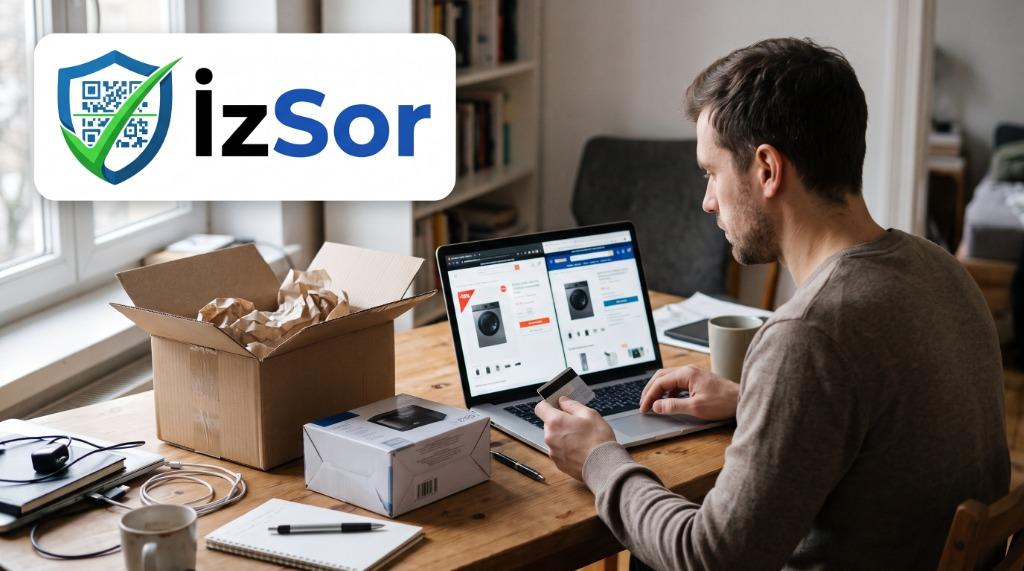
01. The New Equation in a 4.57 Trillion TL Market: Why a 10% Discount Is No Longer Enough
According to Ministry of Trade data, e-commerce volume in Türkiye expanded by 52.2% year-over-year in 2025, crossing the 4.57 trillion TL milestone (Indigo Magazine / E-Commerce Standards Index Analysis, 2026). Online shopping has become a regular habit for 69% of society and a routine repeated at least two to three times a month for 84% of users, signaling market maturity (Anadolu Agency, 2026).
Yet as the market expanded, rising incidents of counterfeit goods, deceptive discounts, and data breaches fundamentally reordered consumer priorities. According to Türkiye's first E-Commerce Standards Index conducted by Veri Enstitüsü for Amazon Türkiye across 2,530 respondents, Trust (48%) ranked first in defining a quality e-commerce experience—ahead of delivery quality (45%), product variety (41%), and easy returns (40%), while competitive pricing (37%) fell to fifth place.
The study's most striking finding is that price discounts fail to overcome the trust barrier: 69% of consumers prefer a known, trusted platform over an unfamiliar shopping website even if the unfamiliar site offers the exact same product at a 10% discount (Anadolu Agency, 2026).
Türkiye E-Commerce Standards Index (N = 2,530): Determinants of a Good Shopping Experience
02. What Does Scientific Literature Say? Perceived Risk, Trust Premium, and Small-Parcel Counterfeiting
The empirical picture emerging from field data in Türkiye aligns directly with findings in the global academic literature:
32,658-Participant Global Meta-Analysis (Handoyo, 2024):
Published in Heliyon by Handoyo (2024; DOI: 10.1016/j.heliyon.2024.e29714), a meta-analysis synthesizing 54 empirical studies (N = 32,658) proved that Trust is the single strongest determinant of online purchasing decisions (effect size r = 0.670, p < 0.001). The study also demonstrated that Perceived Risk (r = 0.471)—encompassing the fear of receiving counterfeit or defective goods—acts as a decisive moderator between trust and purchasing behavior across both high- and low-income economies.
"Trust Premium" Instead of Discount Wars (Soleimani, 2022):
Soleimani's (2022) systematic literature review of 129 peer-reviewed articles in Information Systems and e-Business Management (DOI: 10.1007/s10257-021-00545-0) shows that sellers capable of building institutional and technological trust command a 'price premium' without resorting to destructive price cuts. Consumers willingly pay more to channels that eliminate counterfeit uncertainty and financial risk.
Counterfeit Density in E-Commerce Parcels (OECD, 2021):
Consumer caution is well-founded. According to the OECD report 'E-Commerce Challenges in Illicit Trade in Fakes' (2021; DOI: 10.1787/40522de9-en), counterfeiters easily open low-cost virtual storefronts across a digital landscape of 12 to 24 million e-commerce sites globally; over 90% of counterfeit goods ordered online and seized by customs are shipped directly via individual postal and small parcel packages.
03. The Consumer's 3 Core Trust Criteria and Expecting "Counterfeit Alerts" from AI
Examining the E-Commerce Standards Index reveals three primary pillars that build consumer trust in an online channel (Indigo Magazine, 2026):
Payment and Personal Data Protection
Financial transaction security is no longer a differentiator—it is the baseline entry requirement.
Certainty of Product Authenticity
In screen-based shopping where items cannot be physically inspected prior to purchase, buyers demand concrete proof that the item inside the box is genuine.
After-Sales Support and Accountability
Expecting an accessible corporate resolution mechanism in the event of non-compliance or suspected counterfeiting.
#2 Consumer Expectation from AI (31%): "Advance Warnings on Product Authenticity & Counterfeit Risk"
While one in two consumers expressed openness to using AI shopping tools, the second-highest expectation from AI—at 31%—was 'receiving advance warnings regarding product authenticity and counterfeit risk' (Indigo Magazine, 2026). Yet software-only AI assistants analyzing prices or review patterns cannot by themselves verify whether the physical product inside a delivered parcel is genuine, especially on multi-vendor marketplaces where inventory from multiple suppliers can commingle under a single product listing.
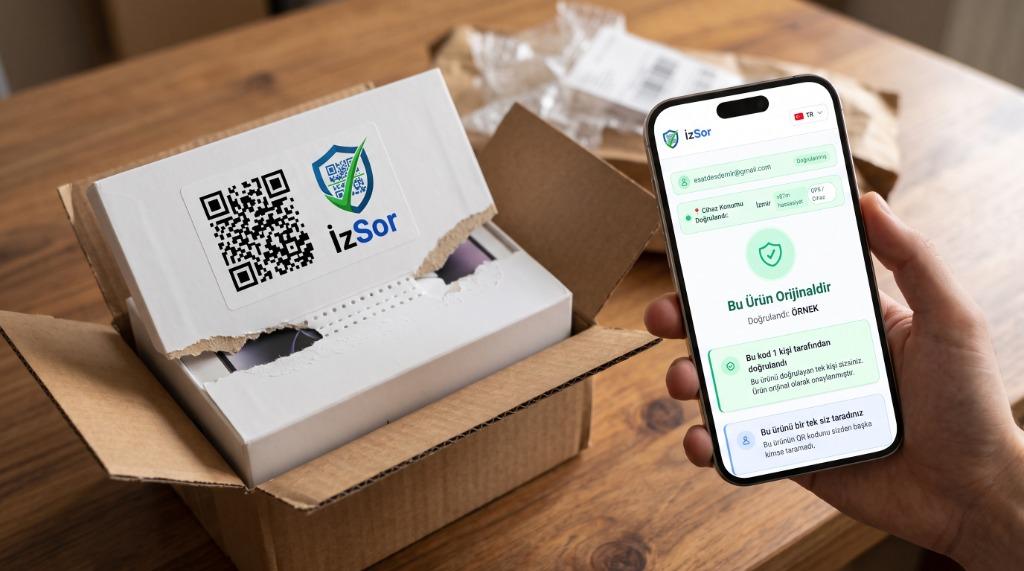
04. Trust Out of the Shipping Box: Platform-Independent Authenticity Proof with İzSor
Traditional barcode and exterior label systems fail to resolve e-commerce authenticity concerns. Experimental security research published in Sensors by Alsuhibany (2025; DOI: 10.3390/s25133855, PMCID: PMC12252379) demonstrates that standard barcodes and unprotected QR codes can be duplicated within seconds using free software (duplication fraud) or swapped onto counterfeit goods (barcode substitution). Similarly, Wang et al. (2023; DOI: 10.3390/s23020795) prove that exposed exterior codes are vulnerable to scan-and-print reproduction.
İzSor overcomes both consumer counterfeit anxiety and the 'trust barrier' faced by honest manufacturers and independent e-commerce stores through its encrypted in-product verification architecture:
| E-Commerce Trust Challenge | Conventional Platform / Outer Barcode Approach | İzSor In-Product Verification Solution |
|---|---|---|
| Seller & Platform Uncertainty | 69% of consumers refuse to buy from new or independent sites even with a 10% discount out of fear of counterfeits. | Trust is embedded directly into the product rather than the platform; shoppers verify authenticity inside the box regardless of where they bought it. |
| Outer Barcode Duplication | Standard exterior barcodes can be copied and affixed onto counterfeit shipments. | The encrypted unit QR code is concealed beneath an inner package flap or seal; it cannot be seen or scanned without opening the box. |
| Return & Swap Fraud | Fraudulent returns where buyers keep the genuine item and return a replica go undetected. | Breaking the inner seal and scanning the İzSor code logs 'This code was verified by 1 person,' immediately exposing opened or swapped units. |
| Illicit Distribution Detection | Brands cannot track which regions cloned products are circulating in. | GPS and device-based location verification detects scan anomalies in real time, alerting both the consumer and the brand. |
05. Strategic Takeaway for Brands and E-Commerce Sites: Compete on Proven Trust, Not Discounts
The data point to a clear commercial reality: sacrificing profit margins to offer a 10% discount fails to persuade 69% of shoppers, whereas proving product authenticity (40% trust driver) directly removes the barrier to purchase (Indigo Magazine, 2026; Soleimani, 2022):
Earn a Trust Premium with the "First and Only Scanner" Guarantee
Highlighting on your D2C storefront or marketplace listing that your products are protected by İzSor gives customers a concrete pledge: 'When you receive and open this box, you can verify on your phone that you are the first and only person to scan it.'
Look for Inner-Package Unit Verification Alongside Fast Shipping
Paying attention not only to delivery speed or discount percentages, but to whether delivered products carry uncloneable inner-package verification codes like İzSor reduces online counterfeit risk to zero.
Counterfeit Products and Discount Traps in Cosmetics Shopping: A Science-Backed Safe Consumption Guide →
TİTCK Q3 2026 inspection data, lead toxicity reaching 19x legal limits, ÜTS barcode cloning vulnerabilities, and inner-lid İzSor verification.
Frequently Asked Questions (FAQ)
Why do online shoppers prefer familiar platforms over cheaper websites?▼
According to Türkiye's first E-Commerce Standards Index, trust is the top priority for 48% of consumers; 69% of respondents refuse to shop from unfamiliar websites even when offered a 10% discount due to fears of counterfeit goods, personal data breaches, and lack of after-sales accountability (Anadolu Agency, 2026).
Does buying from a large, well-known e-commerce platform guarantee that a product is authentic?▼
Major platforms enforce strong controls, but because multi-vendor marketplaces host hundreds of thousands of third-party sellers and small parcels account for over 90% of global counterfeit trade seizures, counterfeit infiltration can still occur (OECD, 2021; DOI: 10.1787/40522de9-en). For definitive assurance, consumers should verify the platform-independent İzSor unit code inside the product's own packaging.
Can AI shopping assistants detect counterfeit products on their own?▼
AI tools can provide valuable early warnings by analyzing price anomalies, suspicious seller profiles, and fake review patterns—and 31% of consumers expect counterfeit warnings from AI (Indigo Magazine, 2026). However, proving the authenticity of the physical item inside the shipping parcel requires combining digital screening with physical in-product encrypted QR verification like İzSor (Alsuhibany, 2025; DOI: 10.3390/s25133855).
How can independent e-commerce sites and SME brands overcome customer counterfeit fears?▼
Academic research demonstrates that third-party security and authenticity verification systems reduce perceived risk and increase purchase intention without requiring price cuts (Handoyo, 2024; Soleimani, 2022). By integrating encrypted İzSor verification seals inside their packaging, brands provide transparent, uncloneable proof of authenticity.
Can an İzSor verification code be copied during shipping or inside a warehouse?▼
No. The İzSor verification code is not printed on the exterior of the shipping carton or product box; it is concealed on an inner layer accessible only when the end consumer breaks the safety strip or inner flap. Upon scanning, the single-use counter and GPS telemetry confirm 'Only you have scanned this product.'
Scientific Bibliography and Official References
All meta-analytic correlations, e-commerce security findings, and index data in this bulletin are verified against the following DOI-indexed peer-reviewed publications and official reports:
- 1.Handoyo, S. (2024). Purchasing in the digital age: A meta-analytical perspective on trust, risk, security, and e-WOM in e-commerce. Heliyon, 10(8), e29714. (PMCID: PMC11044045)
- 2.Soleimani, M. (2022). Buyers' trust and mistrust in e-commerce platforms: a synthesizing literature review. Information Systems and e-Business Management, 20(1), 57–78. (PMCID: PMC8581124)
- 3.OECD (2021). E-Commerce Challenges in Illicit Trade in Fakes: Governance Frameworks and Best Practices. Illicit Trade, OECD Publishing, Paris.
- 4.Alsuhibany, S. A. (2025). Innovative QR Code System for Tamper-Proof Generation and Fraud-Resistant Verification. Sensors (Basel), 25(13), 3855. (PMCID: PMC12252379)
- 5.Wang, T., Zheng, H., You, C., & Ju, J. (2023). A Texture-Hidden Anti-Counterfeiting QR Code and Authentication Method. Sensors (Basel), 23(2), 795. (PMCID: PMC9863413)
- 6.Anadolu Agency & Veri Enstitüsü / Amazon Türkiye (November 2026). Results of Türkiye's First E-Commerce Standards Index. Anadolu Agency Economy Desk & Indigo Magazine Index Analysis.
Capture the Trust Premium with Inner-Box İzSor Unit QR Instead of Eroding Margins with 10% Discounts
Let your customers see 'Verified by 1 person / Only you have scanned this product' the moment they unbox their order—eliminating return swap fraud and exterior barcode cloning.