Counterfeit Products and Discount Traps in Cosmetics Shopping: A Science-Backed Safe Consumption Guide
As cosmetics sales surge during peak November e-commerce campaigns, artificial discount schemes, phishing storefronts, and 1-to-1 cloned counterfeit cosmetics threaten public health. Because standard outer-box barcodes are easily cloned, consumers and brands must move beyond price tags and exterior labels toward inner-product single-item verification technologies like İzSor.
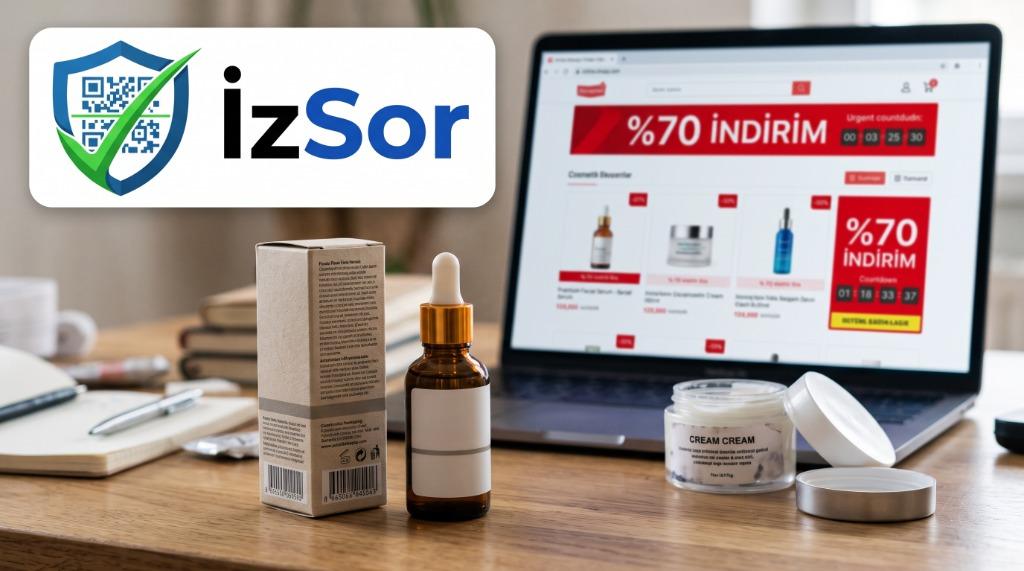
01. Why Do We Make Poor Decisions During Mega-Sales? Digital Dark Patterns
During November shopping festivals and end-of-season sales, online marketplaces and social media ads construct an intense environment of psychological pressure. Second-by-second countdown timers, 'only 2 items left in stock' banners, and flash-sale videos are not accidental design choices.
Recent research in behavioral economics and consumer psychology demonstrates how these persuasive interface patterns bypass rational scrutiny. In a study published by George and Rupa (2025) in Frontiers in Artificial Intelligence (DOI: 10.3389/frai.2025.1684841, PMCID: PMC12580249), countdown timers and artificial scarcity alerts were shown to induce acute urgency, eliminating analytical thinking time and triggering impulsive 'swipe, click, regret' purchasing behavior.
As highlighted by Fuat Arslan, Chairman of the Cosmetics Manufacturers and Researchers Association (KUAD), in his November 11, 2026 statement to Anadolu Agency (AA), counterfeiters specifically exploit these rushed decision moments. Artificially inflated pre-sale prices followed by steep fake markdowns and sponsored phishing links on social media funnel shoppers toward counterfeit cosmetics sold far below genuine production cost.
"Swipe, Click, Regret": Persuasive E-Commerce and Consumer Autonomy
Countdown timers and scarcity cues narrow cognitive evaluation windows, preventing shoppers from verifying seller legitimacy and product authenticity.
Warning Against Fake Sites and Counterfeit Cosmetics in November Sales
KUAD Chair Fuat Arslan warns consumers against artificial price inflation/markdown traps, sponsored social media phishing links, and abnormally cheap counterfeit products.
02. The Scale of the Threat by the Numbers: TİTCK Inspections and Scientific Toxicology Findings
Unregistered cosmetics bought as 'just a moisturizer or perfume' harbor severe chemical and biological hazards capable of crossing the skin barrier into systemic circulation. Q3 2026 inspection data from the Turkish Medicines and Medical Devices Agency (TİTCK) Cosmetics Inspection Department alongside peer-reviewed toxicology literature reveal the concrete magnitude of the risk:
High Non-Compliance Rate (TİTCK Q3 2026):
Out of 95 cosmetic products inspected in Q3 2026 (July–August–September), 57 were found to violate technical regulations or pose direct safety risks, resulting in 11,256,681 TL in administrative fines.
Destruction of Tens of Thousands of Fake Perfumes (Law No. 5324):
During the same period, 40,679 counterfeit and smuggled perfumes seized through law enforcement and institutional referrals were classified as unsafe products under Cosmetics Law No. 5324 and slated for destruction.
Heavy Metals and Carcinogenic Compounds (OECD & EUIPO, 2022):
According to the joint OECD and European Union Intellectual Property Office (EUIPO) 'Dangerous Fakes' report, seized counterfeit cosmetics and perfumes contained known carcinogens including arsenic, beryllium, and cadmium, neuro- and nephrotoxic mercury, illegal levels of hydroquinone, and probable carcinogen DEHP.
Lead Levels Reaching 19x the Legal Limit (Praveen & Swaminathan, 2023):
Published in the Indian Journal of Pharmacy and Pharmacology, cosmetovigilance research documents that lead (Pb) levels in counterfeit cosmetics can reach 5 to 19 times permissible limits—causing severe outcomes ranging from allergic contact dermatitis to endocrine disruption and long-term organ toxicity.
Bacterial and Fungal Infection Threat (Ghias & Fozouni, 2024):
Cosmetics manufactured outside hygienic Good Manufacturing Practices (GMP) or with compromised protective seals are ideal breeding grounds for pathogens. Microbiological analysis published in the Iranian Journal of Public Health revealed heavy microbial growth in 56.25% of contaminated cosmetic samples, isolating Staphylococcus aureus (28.5%), Pseudomonas aeruginosa, and Candida albicans strains linked to resistant skin and ocular infections.
03. Why Traditional Outer Barcodes and ÜTS Lookups Alone Are Not Enough
A vigilant consumer's first step is inspecting the product name, ingredient list (INCI), physical address of the responsible manufacturer or importer, batch/lot number, and Period After Opening (PAO symbol) on the packaging, followed by querying the barcode on TİTCK's Product Tracking System (ÜTS) (AA / KUAD, 2026). Any product absent from ÜTS should never be purchased.
However, against modern counterfeiting operations, relying solely on a standard barcode or exposed QR code printed on the outer carton leaves a critical security vulnerability:
1-to-1 Barcode Cloning
Standard GTIN/EAN barcodes identify a product SKU/line rather than an individual unit box. Counterfeiters copy a valid barcode number from a single authentic cosmetic box and print it in high resolution across thousands of fake cartons. When a consumer looks up that barcode, the registry displays the genuine product record, lulling the buyer into using a counterfeit.
Copy-Print Attacks on Exposed Codes
In packaging security engineering, peer-reviewed research by Wang et al. (2023) published in Sensors (DOI: 10.3390/s23020795) proves that standard codes exposed on the outer surface of packaging offer no intrinsic defense against copy-print attacks; counterfeiters scan, duplicate, and apply outer labels onto imitation packaging.
Counterfeit Refilling of Authentic Bottles
Particularly in luxury fragrances and dermo-cosmetic serums, empty authentic outer cartons and glass bottles are collected, refilled with unregulated illicit chemicals, and reintroduced into the market.
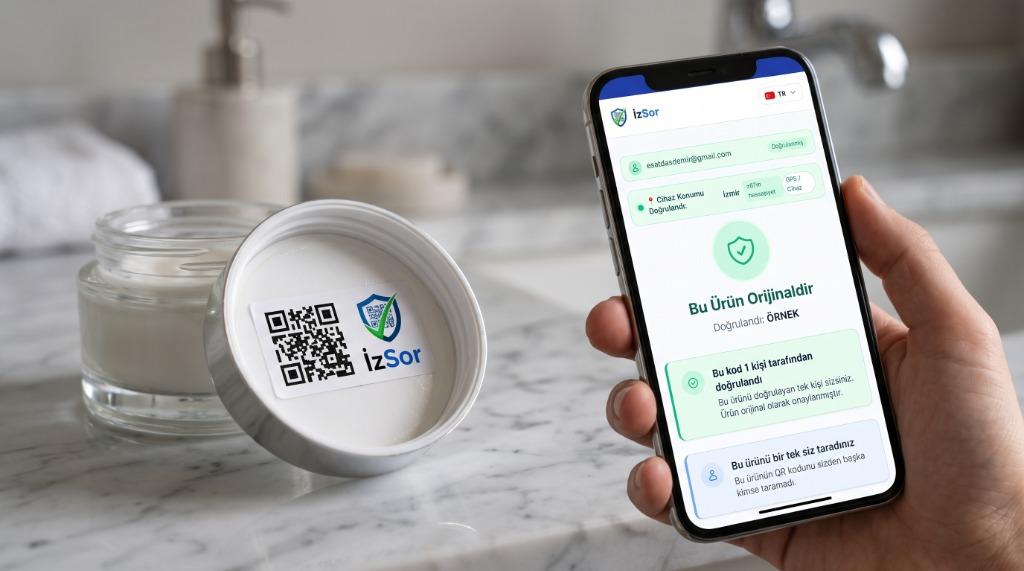
04. The Next-Generation Solution: In-Product, Point-of-Consumption Verification with İzSor
The definitive way to eradicate cosmetics counterfeiting is removing the authentication code from externally photographable surfaces and binding it directly to the physical integrity of the product. İzSor closes this security gap through a unit-level verification architecture placed inside the product that becomes accessible only when the package is opened or consumed.
Key security layers distinguishing İzSor authentication technology from conventional methods include:
| Security Criterion | Conventional Outer Barcode / Standard Lookup | İzSor In-Product Verification Technology |
|---|---|---|
| Code Placement | Exposed on the exterior packaging surface for anyone to access and photograph. | Concealed inside the product cap/lid, beneath the protective foil seal, or on an inner layer revealed during use. |
| Cloning Resistance | A single valid GTIN barcode can be printed onto thousands of counterfeit boxes. | Generates a unique cryptographic QR code per individual unit; invisible and uncopyable before the seal is broken. |
| Scan Count Control | The same barcode can be queried unlimited times without revealing prior duplication. | Proves you are the first and only user via 'This code was verified by 1 person' and 'Only you have scanned this product' alerts. |
| Location & Device Telemetry | Provides zero geographic anomaly or illicit distribution network detection. | Instantly flags suspicious multi-location scans using precise GPS and device-based location verification. |
05. 6-Step Checklist for Safe Cosmetics Shopping
Apply these six evidence-based steps before checkout and upon delivery to protect both your budget and your skin health during promotional campaigns:
Track Historical Price Charts
Before trusting a 'Mega Discount' badge, check independent price history tools to review the product's actual 30-to-90-day price curve.
Ignore Countdown Timers and Suspicious Links
Never click urgency-driven sponsored links from unverified social media accounts; purchase exclusively from the brand's official store or authorized retailers.
Inspect Packaging and Label Integrity
Examine the tamper-evident seal, print quality, INCI ingredient list, full manufacturer/importer address, PAO symbol, and batch/lot code upon delivery.
Use ÜTS Registry Lookup as an Initial Filter
Query the barcode on TİTCK's ÜTS system to confirm the product is not unregistered, while remembering that outer barcodes can still be cloned onto fake boxes.
Choose Brands Protected by İzSor Inner Verification
Scan the inner İzSor verification code revealed when opening the cap or inner seal with your smartphone to confirm that you are the first and only person to scan that unit.
Perform a Skin Patch Test
Instead of applying a new cosmetic product directly across your face, test a small amount on your inner forearm or behind the ear; if redness, burning, or swelling occurs, discontinue use immediately and consult a physician.
Trust Beats Price in E-Commerce: How Counterfeit Concerns Are Reshaping Consumer Choices →
Inside Turkey's 4.57 trillion TL e-commerce market: the 69% trust threshold, Handoyo's (2024) 32,658-participant meta-analysis, and platform-independent İzSor box-interior verification.
Frequently Asked Questions (FAQ)
How can I spot a counterfeit cosmetic product?▼
Counterfeit cosmetics typically exhibit pricing far below market averages, faded print or spelling errors on packaging, missing protective shrink-wrap or safety seals, and harsh chemical odors or separated textures that differ from the original (AA / KUAD, 2026). For definitive proof, choose products equipped with uncloneable İzSor inner-product unit verification codes.
Does a ÜTS barcode lookup definitively prove a cosmetic product is authentic?▼
No. While a ÜTS lookup is an essential preliminary filter showing whether a product's barcode is registered with the Ministry of Health, standard exterior GTIN barcodes are identical across an entire product batch and can be copied from genuine boxes onto counterfeit packaging (Wang et al., 2023; DOI: 10.3390/s23020795). Unit-level İzSor codes concealed inside the product and scannable only upon opening provide far higher security.
What are the skin and health dangers of counterfeit cosmetics?▼
Scientific analyses show that counterfeit cosmetics can contain lead up to 19 times legal limits alongside mercury, arsenic, cadmium, hydroquinone, and pathogenic bacteria such as Staphylococcus aureus and Pseudomonas aeruginosa (Praveen & Swaminathan, 2023; Ghias & Fozouni, 2024). These contaminants cause severe allergic contact dermatitis, chemical burns, eye infections, endocrine disruption, and long-term liver, kidney, and nervous system damage (OECD/EUIPO, 2022; DOI: 10.1787/117e352b-en).
How can shoppers detect deceptive discounts (price traps) during November sales?▼
Some sellers artificially inflate list prices prior to campaign days to create the illusion of a steep discount (AA / KUAD, 2026). Reviewing 30-to-90-day price history charts, comparing current prices across authorized retailers, and refusing to rush under countdown timer pressure are the most effective defenses (George & Rupa, 2025; DOI: 10.3389/frai.2025.1684841).
How does the İzSor in-product verification system protect consumers?▼
The İzSor authentication code is placed not on the exposed outer carton, but on an inner layer revealed only when the product is opened or consumed. When a consumer scans this unique QR code with a smartphone, the system performs GPS location verification and immediately confirms that they are the first person to scan it ('Only you have scanned this product'), eliminating cloned-label and refilled-bottle risks.
Scientific Bibliography and Official References
All toxicological, microbiological, behavioral, and regulatory data cited in this bulletin are verified against the following DOI-indexed peer-reviewed articles and official agency reports:
- 1.OECD & EUIPO (2022). Dangerous Fakes: Trade in Counterfeit Goods that Pose Health, Safety and Environmental Risks. Illicit Trade, OECD Publishing, Paris.
- 2.Praveen, J., & Swaminathan, T. V. (2023). Cosmetovigilance: Emerging safety trends. Indian Journal of Pharmacy and Pharmacology, 10(3), 132–141.
- 3.Ghias, M., & Fozouni, L. (2024). Assessment of Microbial Contamination and Metabolite Exposure in Cosmetic Products Used in Women's Beauty Salons. Iranian Journal of Public Health, 53(5), 1175–1183. (PMCID: PMC11188661)
- 4.George, A. M., & Rupa, R. (2025). Swipe, click, regret: an opinion on persuasive e-commerce and consumer autonomy. Frontiers in Artificial Intelligence, 8, 1684841. (PMCID: PMC12580249)
- 5.Wang, T., Zheng, H., You, C., & Ju, J. (2023). A Texture-Hidden Anti-Counterfeiting QR Code and Authentication Method. Sensors (Basel), 23(2), 795. (PMCID: PMC9863413)
- 6.Morse, B. L., & Repsha, C. L. (2020). Pretty Poisonous: How Counterfeit Cosmetics Can Be Toxic to Student Skin. NASN School Nurse, 36(1), 58–61. (PMID: 32476562)
- 7.Republic of Türkiye Ministry of Health TİTCK (2026). Q3 2026 Cosmetics Market Surveillance and Inspection Data. Cosmetics Inspection Department Official Announcement.
- 8.Anadolu Agency & KUAD (November 11, 2026). Warning in Cosmetics: 'Beware of fake websites and counterfeit products during November discounts'. Anadolu Agency Economy Desk / KUAD Announcements.
Eliminate Illicit Refilling and Barcode Cloning with Inner-Lid & Under-Foil İzSor Unit QR
Do not let cloned outer barcodes compromise your brand equity and consumer skin safety. Deploy İzSor's inner-product verification architecture delivering 'Only you have scanned this product' assurance upon opening.